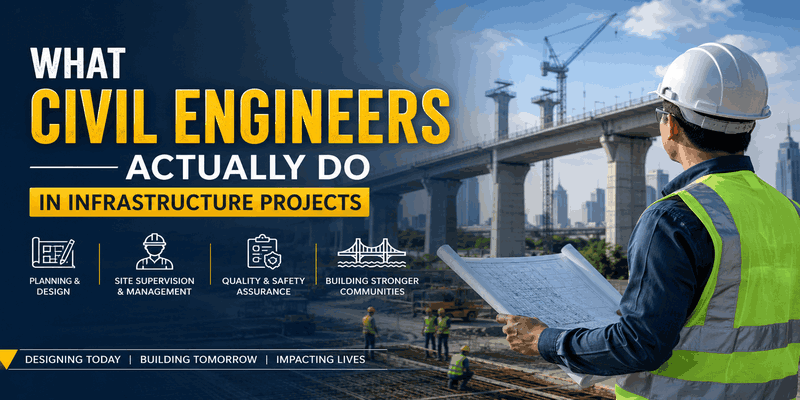
What Civil Engineers Actually Do in Infrastructure Projects
Key Takeaways
- Civil engineers evaluate project feasibility before construction begins to reduce technical and financial risks.
- Structural design focuses on safety, durability, material selection, and compliance with engineering standards.
- Civil engineers manage construction schedules, budgets, quality, and site supervision throughout project execution.
- Sustainable infrastructure planning improves resilience, reduces environmental impact, and supports long-term performance.
- Modern civil engineering relies on ontologies such as BIM, GIS, drones, digital twins, and AI-assisted design.
- Building Information Modeling (BIM) improves collaboration, reduces design conflicts, and supports efficient project delivery.
- Civil engineers work with multidisciplinary teams to deliver infrastructure projects that meet technical, environmental, and community needs.
- Strong technical knowledge, project management skills, and digital expertise are essential for success in today's civil engineering profession.
Also Read : Some vital notes for civil engineers
The role of civil engineers in infrastructure development is broader than most people realize. They don't just draw blueprints. They assess whether a project is even worth building, design structures that must stand for decades, manage teams on site, and increasingly, build digital models that let every stakeholder - from contractors to city councils - understand exactly what's being built before a single shovel hits the ground.
The American Society of Civil Engineers (ASCE) defines five leadership roles for civil engineers in modern infrastructure: master designer, steward, innovator and integrator, risk manager, and leader and decision maker. Each of these maps to a concrete phase of project delivery.
Here's how those roles play out in practice.
1. Planning and Feasibility: Deciding What Gets Built (and What Doesn't)
Every infrastructure project starts with a question: Is this actually viable? Civil engineers answer it through feasibility studies - structured analyses that assess technical, economic, regulatory, and environmental factors before any design work begins.
A well-run feasibility study covers:
- Technical feasibility - site geology, soil conditions, hydrology, and construction method constraints.
- Economic feasibility - lifecycle cost estimates, NPV and IRR calculations, and benefit-cost ratios
- Regulatory and environmental - permit requirements, environmental impact assessments (EIAs), and statutory compliance
- Operational feasibility - workforce availability, supply chains, and realistic timelines
This phase is where civil engineers earn their keep as risk managers. Catching a fatal flaw in a feasibility study costs a fraction of what it costs to catch it during construction - or after a structure fails.
Civil engineers also lead site selection, traffic impact analysis, and utility coordination at this stage. They're the ones who translate a politician's vision for a new highway interchange or a developer's sketch of a water treatment plant into a grounded assessment of what it will actually take to deliver it.
Also Read : An extensive list of formulas and equations for civil engineers
2. Structural Design and Engineering: Making It Safe and Buildable
Once feasibility confirms a project is worth pursuing, civil engineers move into structural design. This is the technical core of the profession - calculating load-bearing capacities, specifying materials, and producing the drawings and specifications that contractors will build from.
Key responsibilities in this phase:
- Structural analysis - modeling forces, stresses, and deflections to ensure safety margins are met.
- Material specification - selecting concrete mixes, steel grades, and geosynthetics suited to site conditions.
- Hydraulic and geotechnical design - sizing drainage systems, designing foundations, and managing groundwater.
- Code compliance - ensuring every element meets local, national, and international standards
Civil engineers don't design in isolation. A bridge project, for example, involves geotechnical engineers assessing the riverbed, structural engineers sizing the deck and piers, hydraulic engineers modeling flood flows, and transportation engineers designing the approach roads.
3. Project Management and Site Supervision: Delivering on Time and on Budget
Designing a structure and building it are two very different challenges. Civil engineers bridge that gap through project management and site supervision - the operational roles that turn drawings into physical reality.
As project managers, civil engineers:
- Develop and track construction schedules using tools like Primavera P6 or MS Project.
- Control costs through quantity take-offs, change order management, and budget forecasting.
- Coordinate subcontractors, suppliers, and regulatory inspectors
- Manage risk registers and respond to unforeseen site conditions
On site, they shift into a supervisory role - verifying that materials match specifications, that construction methods follow the approved plans, and that safety protocols are enforced. This is where quality control happens in real time.
A civil engineer on a major highway project might spend mornings reviewing concrete pour logs, afternoons walking the alignment to check compaction testing results, and evenings updating the project schedule. It's hands-on, detail-intensive work that generic job descriptions rarely capture.
Communication is a core competency here. Civil engineers regularly brief clients, government agencies, and community stakeholders - translating technical progress into plain language that non-engineers can act on.
4. Sustainability and Resilience: Building for the Next 100 Years
Infrastructure built today will still be in service in 2075 and beyond. That makes sustainability and climate resilience central to the civil engineer's role - not optional extras.
ASCE Policy Statement 418 (updated July 2023) is explicit: civil engineers "shall be committed" to sustainable development principles, including performing life-cycle assessments from planning to demolition, minimizing non-renewable resource use, and incorporating resilience against changing conditions.
In practice, this means:
- Green infrastructure - permeable pavements, bioswales, green roofs, and urban forests that manage stormwater naturally instead of relying purely on grey concrete systems
- Climate-adapted design standards - some agencies now design to the 500-year flood threshold rather than the 100-year standard, reflecting updated climate projections
- Low-carbon materials - heat-resistant concrete formulations, recycled steel, and modular construction techniques that reduce embodied carbon
- Lifecycle thinking - designing structures so components can be reused or upcycled at end of life, not just demolished
The financial case is clear: the World Federation of Engineering Organizations (WFEO) estimates that every $1 invested in resilient infrastructure can generate up to $10 in avoided losses over a decade. Civil engineers who ignore sustainability aren't just failing the environment - they're delivering worse value for money.
NYU Tandon's Department of Civil, Urban, and Environmental Engineering frames this directly in its mission: developing innovations for smart, resilient, and sustainable cities, with a focus on transportation, water, and power networks as interconnected systems.
5. Technology Adoption: Digital Tools Reshaping the Profession
Civil engineering has always been a technically demanding field. What's changed in the last decade is the speed at which digital tools have become essential rather than optional.
The core technologies reshaping infrastructure delivery right now:
- GIS and remote sensing - for site analysis, terrain modeling, and environmental mapping.
- Drone surveys - replacing weeks of traditional surveying with hours of aerial data collection.
- Finite element analysis (FEA) software - for complex structural simulations.
- Digital twins - live virtual replicas of infrastructure assets that support ongoing operations and maintenance.
- AI-assisted design - emerging tools that optimize structural layouts and flag code compliance issues automatically.
By 2030, BIM proficiency is projected to be an essential professional skill for civil engineers - not a differentiator, but a baseline expectation. Employers are already treating it that way.
How Civil Engineers Use 3D Modeling and BIM for Infrastructure Design
This is where the profession has shifted most dramatically - and where the gap between generic institutional content and real-world practice is widest.
Building Information Modeling (BIM) isn't just 3D drawing. It's a process of creating and managing a shared digital model that contains geometry, material data, cost information, and construction sequencing - all in one place. For infrastructure projects, BIM enables something that 2D drawings never could: a single source of truth that every discipline works from simultaneously.
About the Author
Rajib Dey is a professional Content Writer with a passion for creating engaging, informative, and search-friendly content. He specializes in transforming complex topics into clear, reader-focused narratives that drive engagement and deliver value. With expertise in content strategy, SEO writing, and digital storytelling, Rajib develops high-quality articles, blogs, website copy, and thought leadership content across diverse industries. His commitment to research, accuracy, and audience-centric writing helps brands strengthen their online presence and connect meaningfully with their target audiences. Follow him on Linkedin.
Frequently Asked Questions
1. What skills does a civil engineer need for infrastructure projects?
Civil engineers working on infrastructure need a combination of technical and interpersonal skills. On the technical side: structural analysis, geotechnical assessment, hydraulic design, GIS proficiency, and increasingly BIM/3D modeling competency. On the interpersonal side: project management, stakeholder communication, and the ability to coordinate multidisciplinary teams. The ASCE identifies analytical thinking, problem-solving, and decision-making under uncertainty as non-negotiable core competencies.
2. How do civil engineers ensure project sustainability?
Civil engineers apply sustainability through lifecycle assessment - evaluating environmental, social, and economic impacts from planning through demolition or reuse. Practically, this means specifying low-carbon materials, designing for climate resilience (updated flood return periods, heat-resistant materials), integrating green infrastructure where appropriate, and using rating tools like the Envision™ Rating System to validate sustainability outcomes. ASCE Policy Statement 418 sets the professional standard.
3. What is the difference between a civil engineer and a structural engineer?
Structural engineering is a specialty within civil engineering focused specifically on the load-bearing elements of a structure - beams, columns, foundations, and connections. Civil engineers work across a broader scope that includes transportation, water systems, geotechnics, and environmental engineering, in addition to structural work. On large infrastructure projects, you'll typically have both: a civil engineer leading overall project delivery and a structural engineer responsible for specific structural elements.
4. How do civil engineers use BIM in infrastructure projects
Civil engineers use BIM to create shared digital models that integrate geometry, material data, cost information, and construction sequencing. In infrastructure, this typically involves tools like Autodesk Civil 3D for parametric corridor and grading design, Revit for structural elements, and SketchUp for conceptual modeling and stakeholder visualization. The models are coordinated in platforms like Navisworks or Trimble Connect, where clash detection and multidisciplinary review happen before construction begins.
5. What types of infrastructure do civil engineers design?
Civil engineers design and oversee virtually every category of built infrastructure: roads and highways, bridges and tunnels, dams and levees, water treatment and distribution systems, wastewater systems, airports, ports, railways, and urban drainage networks. They also work on green infrastructure - bioswales, permeable pavements, and urban parks - and increasingly on digital infrastructure like sensor networks embedded in smart city systems.
How long does it take to become a civil engineer?
In the United States, becoming a licensed Professional Engineer (PE) in civil engineering typically requires a 4-year accredited bachelor's degree (ABET-accredited), passing the FE (Fundamentals of Engineering) exam, 4 years of supervised professional experience, and passing the PE exam. Many civil engineers also pursue master's degrees - programs like NYU Tandon's M.S. in Urban Infrastructure Systems - to specialize in areas like transportation, structural engineering, or urban systems management.